
Because the Job Doesn’t End When the System Is Installed
Physical security managers in large organizations face ever-increasing complexity across large campuses and hundreds of additional locations. Physical security systems may vary widely from location to location, and most mix legacy and newer technologies freely. Many companies continue to make major investments in security system modernization, retrofits, and optimization of existing systems.
Despite all that complexity — or perhaps because of it — some physical security leaders feel like they’re spending too much time directing traffic, not leading.
They end up functioning as middlemen between their organizations and the security integrators they work with.
Why does this happen? Because most large organizations lack a single source of truth for physical security.
As systems grow more complex and properties more numerous, without physical security asset tracking, organizations may not even know what’s installed, let alone where each device is, whether devices are working, when they’ll reach end of life, or how systems interconnect.
The answer most organizations lack is a digital living as-built, a reference that serves as an ongoing single source of truth.
Below are the five most important reasons why every organization needs one. Throughout, we’ll highlight unique insights from two System Surveyor team members:

Shelby Chatigny is an account executive with more than 5 years of experience within physical security, bringing a unique perspective from both the manufacturer and integrator worlds.

Tradd Kendrick is a senior account executive and business development leader with experience working for physical security manufacturers. He works with new and existing customers to better optimize their workflows using the System Surveyor platform.
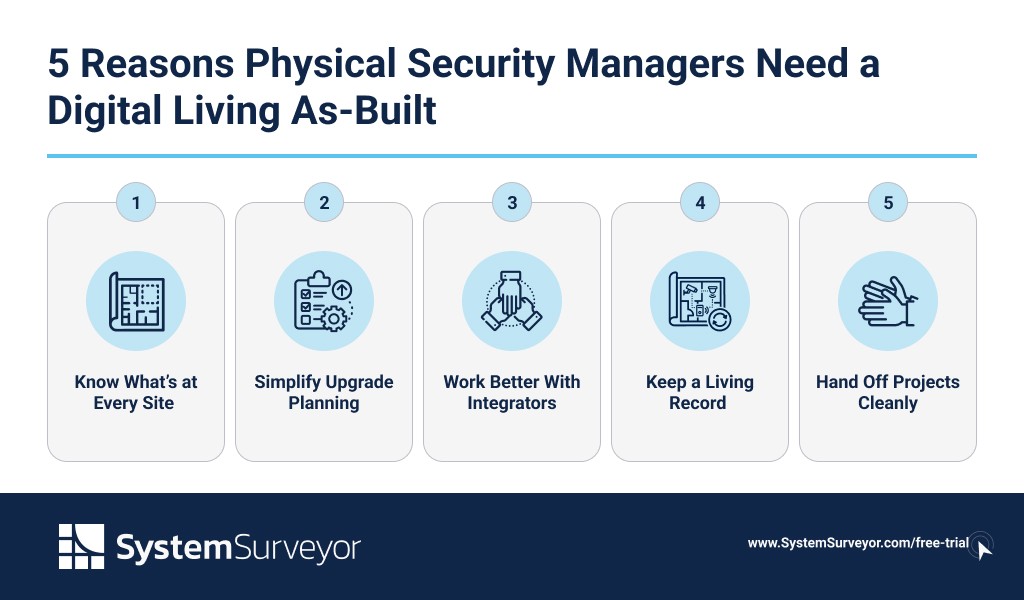
1. Know What You Actually Have Across Every Site
Where does your organization store information about devices, locations, and system configurations?
For most, that security system documentation is scattered across drawings, spreadsheets, PDFs, and “institutional knowledge” (read: it only exists in that one staffer’s head, and they just quit).
Tradd calls that approach “not scalable” and points to the surprising leanness of most physical security teams:
“It’s incredible: these 2-6 person teams that Fortune 500 customers have in place manage 300+ sites with new ones coming online all day. But they can’t be everywhere at once.”
Shelby describes how she’s seen this play out:
“One of the biggest challenges is maintaining visibility and control over your physical security environment across every location. For Fortune 500 companies with locations across the country or around the globe, that often means working with multiple system integrators. But when each integrator manages the documentation separately, information becomes fragmented. Companies that rely entirely on those partners to maintain that data can lose direct access to the information they need to manage its devices, plan upgrades, and understand what is installed at each site.”
What multi-site physical security management requires is a central system with regional integrator access to ensure everything is being tracked, updated, and budgeted for correctly.
This system must include an accurate security device inventory covering cameras, access control, intrusion and other physical security assets so that teams can quickly:
- Understand differences between locations
- Identify what has changed since the original installation
- Reduce dependence on institutional knowledge
Over time, this level of detail will support efforts to create more consistency across multi-site environments, which leads us to our next big reason large organizations need a digital as-built.
2. Make Future Upgrades and Retrofits Easier to Plan
No physical security system is ever really “finished.”
Yes, projects have a completion date. But systems don’t stay the same across the security system lifecycle. Technology changes. Physical security assets fail. Facility uses and usage patterns evolve.
But keeping up with any of it requires knowing what you’re working with.
As large organizations are making multi-million-dollar investments in security system modernization and optimization, they need to know what they’re modernizing and optimizing.
When you have an accurate digital record, you have a clear starting point for security system retrofit planning, from incremental upgrades to major replacements. You don’t have to rediscover the environment first. In Shelby’s words:
“An accurate record of your existing environment is the foundation for planning future upgrades. You need to know what is installed, where it is, and what condition it is in before you can decide what to replace, expand, or standardize.”
This is all true for organizations at any scale, but the added complexity of multi-site physical security makes it even more important to have comprehensive security system documentation and a digital as-built. Shelby again:
“For large enterprises and Fortune 500 companies, that gets more complicated when multiple system integrators support different locations. Without consistent documentation, teams can end up repeating site visits, budgeting with incomplete information, or discovering unexpected requirements once a project is underway.”
Having a digital as-built is a key step toward easier planning of future security system upgrades and retrofits. But Shelby’s comment about managing multiple security integrators points to our third reason this resource is so important.
3. Collaborate More Effectively With Integrators
Traditionally, end users (physical security professionals) have viewed the relationship with system integrators as fairly transactional: you need a new system (or a replacement camera), the integrator designs and installs, and that’s the end of the relationship.
But that’s changing as the technology those integrators are selling you gets more complex and interrelated.
Modern integrators are doing more than just installing what the customer specifies. More and more, they’re helping customers design, optimize, and manage complex physical security environments. Some integrators are even becoming partners that deliver ongoing value.
But here’s the key: for this to work, everyone needs to be working from the same information: shared security system documentation.
This is especially important if you’re working with multiple integrators across projects or regions.
With a shared visual record, end users and integrators gain a common reference point for security integrator collaboration. From there, they can much more easily communicate requirements, identify changes, and review proposed solutions.
This kind of visual record improves the process end to end, reducing ambiguity and back-and-forth during proposals and physical security system design and adding continued clarity all the way through installation and beyond.
4. Maintain a Record That Evolves With the System
A traditional as-built becomes outdated the second it gets printed. A digital living as-built doesn’t.
- Devices get replaced
- Cameras move
- Spaces get renovated
- Systems undergo expansion
- Old equipment is taken offline
- New technologies get bolted on
If you’ve ever taken over a system you did not oversee from the beginning, you know this frustration firsthand.
We asked Shelby and Tradd what information they wished they’d had at their fingertips when taking over an existing security environment.
Shelby: “A clear picture of what is installed, where it is, and how it all connects. That should include accurate floor plans, device locations, makes and models, installation dates, maintenance history, and photos that show the actual conditions on site. I would also want to know which integrator supports each location and where there are known issues or coverage gaps.”
Tradd adds: “I’d also want a history of the install dates, warranties, and sensitive information (like IP addresses) in a repository. Having that would’ve saved me hours hunting down information across systems, spreadsheets, and emails.”
Don’t Forget the Configuration Details
Tradd’s point about sensitive information deserves a closer look. A complete digital as-built isn’t only about where a device sits on a floor plan. It also includes the configuration details needed to actually manage that device: IP addresses, passwords, subnet masks, MAC addresses, firmware versions, and serial numbers.
This came up again and again at our recent THRIVE user conference in Austin. End users and system integrators kept asking versions of the same questions: How is everyone else managing device configurations? How do you share them between the customer and the integrator without passing around a spreadsheet? And how do you keep all of it secure?
They’re fair questions. For many organizations, the shared spreadsheet is still the default, and it creates real problems:
- Passwords and IP addresses sit in plain text, often in email attachments or shared drives
- Copies multiply and no one is sure which version is current
- There’s no easy way to control who sees what or to cut off access when an integrator or employee moves on
- Technicians can arrive on site without the details they need, which can mean another truck roll
That’s why System Surveyor built InfoMask™ into the platform. InfoMask encrypts sensitive device configuration information and stores it with the device itself, inside the system design and digital as-built, rather than in a separate file that can be copied, forwarded, or forgotten.
Authorized users can reveal those details with a click when they need them, and the information is masked again after 30 seconds. Because access is limited to authorized users, integrators, installers, and operations teams can get what they need to do the job, while passwords and network details stay protected.
And because the configuration data lives in the as-built, it stays available for the life of the system, not just through installation. When a camera is replaced, a device is readdressed, or a new integrator takes over a region, everyone works from the same secure, current record.
A digital as-built solves both Shelby’s and Tradd’s concerns. It can be easily updated as your system changes, giving physical security teams and system integrators alike a clear picture of what the system looks like right now.
This capability allows organizations to give teams visibility into the current state of the environment, maintain continuity from project to project, preserve institutional knowledge, and support ongoing security system lifecycle management.
5. Create a Better Handoff From Project to Lifecycle Management
Getting back to the idea of lifecycle management and providing ongoing value: a digital as-built supports all kinds of ongoing lifecycle management tasks, including maintenance (backed by security system maintenance records), troubleshooting, expansion, budget planning, and system upgrades.
The living as-built also serves as your knowledge repository, providing for physical security knowledge transfer that doesn’t depend on any one employee.
There’s also the possibility of better coordination with vendors and integrators.
Taken together, all of these create a better, smoother experience over the life of a system, not just during design and installation.
Own Your Data… Including Your As-Builts
In the traditional model, integrators might take their plans home with them when a project ends, but that isn’t viable for today’s organizations, which increasingly expect security documentation ownership. Shelby observed at GSX that more and more large organizations “want ownership of their environment instead of relying solely on their integrator.”
“End users are demanding more ownership over their own data and need ot have the ability to make independent decisions,” explained Tradd.
The End User and Integrator Need the Same Source of Truth
There’s a reason security integrators persist. They bring technical expertise and experience designing and implementing physical security solutions that most organizations can’t replicate internally.
At the same time, end users at large corporations bring equally vital elements to the table: knowledge of organizational priorities, an understanding of existing facilities, and ownership of security requirements.
Both are necessary for high-performing physical security. But both need the same source of truth.
Technology can provide that source of truth and connect the perspectives of integrators and physical security leaders throughout the lifecycle. When that source of truth is both shared and visual, the collaboration becomes even more practical.
System Surveyor supports the relationship between physical security end users and system integrators from design through installation and throughout the system’s lifecycle. The cloud-based security system design platform gives physical security end users and integrators one visual record of the system, from the initial design through installation, with a digital as-built they can keep updating over the system’s life. See for yourself and start a free trial today.
Frequently Asked Questions
A digital living as-built is an up-to-date visual record of a physical security system, including device locations, floor plans, equipment details, installation information, and system configurations. Unlike traditional as-built documentation, it can be updated as devices are replaced, spaces change, and systems expand.
Digital as-builts give physical security teams a reliable source of truth for what is installed across their locations. They help teams track assets, identify changes, reduce reliance on institutional knowledge, plan upgrades, and maintain visibility across complex, multi-site environments.
A digital as-built centralizes security system documentation across locations, helping teams understand differences between sites, track devices, coordinate with multiple integrators, and plan upgrades with more accurate information. This is especially valuable for lean security teams responsible for hundreds of locations.
Digital as-builts provide security teams and integrators with a shared visual reference for device locations, system configurations, and project requirements. This makes it easier to communicate changes, review proposed solutions, reduce misunderstandings, and maintain continuity from design and installation through ongoing maintenance.
A digital living as-built helps teams manage security systems beyond installation by maintaining current information about devices, configurations, and site conditions. This documentation supports troubleshooting, maintenance, expansion, budget planning, and future upgrades.
Useful documentation includes accurate floor plans, device locations, equipment makes and models, installation dates, maintenance history, site photos, known issues, coverage gaps, and information about the integrator supporting each location. Keeping this information current helps teams make informed decisions about their security systems.
Physical security end users benefit from maintaining direct access to their security system documentation rather than relying solely on integrators to preserve it. Shared documentation allows end users and integrators to collaborate while giving organizations greater control over their security data and future planning.
System Surveyor is a cloud-based physical security system design platform that gives end users and system integrators a shared visual record of security systems. Teams can document designs and device locations, collaborate throughout installation, and continue updating their digital as-builts as systems evolve.

Maureen Carlson is co-founder and president of System Surveyor, the leading digital platform for physical-security site surveys and system design. With 25 + years in B2B SaaS and security technology, she leads the go-to-market and operations with a top notch team. Under her leadership, System Surveyor has grown into an industry-defining software used worldwide to streamline system design, enable collaboration, and raise the bar for security and technology professionals. Maureen enjoys building relationships in the industry and user community to build sustainable, high growth business. In her spare time in beautiful Austin, you’ll find her spending time outdoors, on a tennis court, reading or with family and friends.