

It usually starts with a small question.
“Hey, do we have a photo of that door?”
“Can you confirm which side the IDF is on?”
“Is that camera count final, or are we still adjusting it?”
One question turns into three. Three turns into a thread. Then a call. Then a quick follow up. Then another version of the scope. Nobody panics because the security system projects are still getting done.
But week after week, the business keeps paying for the same gaps in the same places, and it rarely shows up as one obvious problem you can point to.
It shows up as the cost of inaction. The cost of leaving the process as-is, even when everyone knows it could be tighter.
A Common Pattern, Quiet Friction
If you have ever worked in security integration, you have seen this play out.
The site survey is done. Sales hands it off. PM’s start building out the project. Ops weighs in. The field asks for clarification. Someone realizes a photo is missing, a detail was not captured, or a security device location was assumed.
So the team does what good teams do. They adapt and work around it.
But all those workarounds have a price.
Not because people are careless, but because the process is leaning too hard on tribal knowledge and scattered information when everyone within their respective departments are juggling multiple projects at once.
The Real Question Security Leaders Are Quietly Asking
Most security leaders I talk to already know parts of their security system design process are inefficient. I have even felt this in the field when I worked in security integration. Security integrators feel it in the constant clarifications and the extra touches it takes to get a scope right.
And it is not just an operations problem. They want to fix it because it directly impacts revenue.
Close more.
Win more.
Move faster without creating chaos downstream.
So, the question becomes simple. What is this costing you every month, and how much more could you take on if the process was tighter?
Because the biggest expense is rarely the change you are considering. It is the steady drain you are already paying for on every physical security system project in time, revisits, and cleanup that never shows up as a line item on the P&L statement.
Tightening the Handoff
The fastest wins usually come from going back to the beginning and tightening the handoff.
Not adding more steps.
Not adding more meetings.
Just getting clear on what accuracy looks like between sales, design, ops, and the field.
When teams agree on what must be captured during the site walk, what must be visible to everyone, and what must be confirmed before a proposal goes out, the downstream confusion drops.
Collaboration That Reduces Rework
The teams that feel the most in sync do not have perfect people.
They have a repeatable process and systems in place.
Handoffs that are consistent.
A shared place to review scope and site context. Some people call it “the single source of truth”.
A simple way for engineering, ops, and field to flag gaps early.
That is what collaboration looks like in the real world. It is not a slogan. It is the daily discipline that keeps small issues from turning into rework.
Fine Tuning the Processes That Matter Most
The goal is not to rebuild your physical security systems workflow from scratch.
The goal is to remove the parts that create the same confusion every time.
In my experience working in security integration, the biggest leverage points tend to be:
- Capturing site details in a consistent format on a digital security survey, not just in someone’s notes.
- Making photos and security device context easy to find later, not buried in a camera roll or an email thread.
- Keeping scope, assumptions, and changes visible to everyone involved from the first initial site visit.
When these three things improve, you see fewer clarifying questions, fewer unplanned trips, and fewer late-stage surprises that force people to improvise and chip away at margin.
The Quiet Math That Adds Up Fast
You do not need perfect data to see the problem.
Simple back of the napkin math will do.
Here is one example:
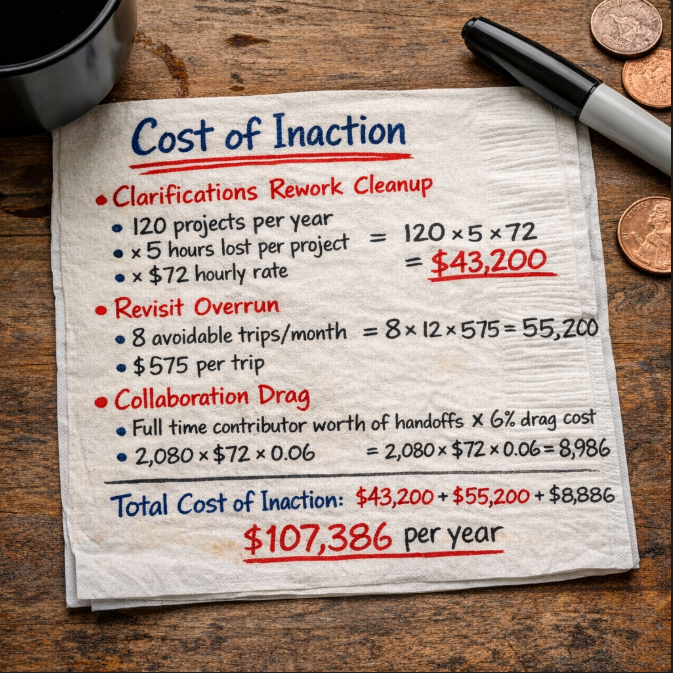
120 projects per year
5 hours lost per project to clarifications, rework, and version cleanup
$72 blended hourly rate
That is 120 × 5 × 72 = $43,200 per year.
Now add avoidable revisits.
8 unplanned site trips per month
$575 all in cost per trip
That is 8 × 575 × 12 = $55,200 per year.
You are already at $98,400.
Then add collaboration drag.
This is the time that disappears in handoffs, clarifying threads, and internal back and forth that feels small in the moment, but compounds all year.
A simple way to estimate it.
1 full time contributor worth of handoffs across sales, design, ops, and field
2,080 hours per year
$72 blended hourly rate
6% drag from constant alignment work
That is 2,080 × 72 = $149,760 per year.
Then 149,760 × 0.06 = $8,986 per year.
Total cost of inaction in this example: $43,200 + $55,200 + $8,986 = $107,386 per year.
And that is before you count what happens when proposals slow down, timelines slide, or the install team has to figure it out once the job is already awarded and they are onsite.
How To Spot the Gaps Before They Compound
If you want one practical step that mirrors the structure of this whole conversation, do this with your team this week.
Pick one recent job that felt normal, but took longer than it should have.
Then answer these three questions together.
- What was the very first detail someone had to chase down after the site survey
- Where did that information live, and why was it not visible to everyone
- What is the simplest change that would prevent that same chase next time
That exercise almost always surfaces the real gaps in your security system design process.
Not a big dramatic failure.
The small, repeated gap your team keeps paying for.
Building a Single Source of Truth Across Sales to Ops
Here is where System Surveyor helps make the fix stick.
It gives your team one digital as-built where floor plans, device locations, notes, and photos live together.
So, the next person is not guessing or hunting.
Instead of endless revisions from emailed PDFs and scattered edits, sales, design, ops, and the field can reference the same live plan.
Photos and notes stay tied to the exact device in question, not buried in someone’s camera roll.
You can also bring the right people into the review early using guest access.
That way clarifications happen while the site is still fresh, not weeks later.
And because what gets captured during the site walk can roll into an automated bill of materials and clean reporting, estimating and delivery are working from what was actually documented.
That is what keeps everyone aligned from the first site walk through install.
FAQs
It is the ongoing cost of keeping a process the same when you already know where the friction lives. It shows up as rework, unplanned site trips, slower proposals, and extra coordination time across teams.
Start with projects per year × hours lost per project × blended hourly rate. Then add unplanned revisits. You do not need perfect accuracy. You need a reasonable estimate that makes the tradeoff clear.
At the handoff. When the site walk output and security survey is consistent and shareable, and everyone is working from the same set of details, the clarifications and rework drop dramatically. A shared digital security survey that ties photos, device context, and reports together helps make the process repeatable and accurate across all security integration projects.

Shelby Chatigny is an Account Executive at System Surveyor, the leading digital platform for physical security site surveys and system design. With 5+ years of experience across the physical security industry, she brings a unique perspective from both the manufacturer and integrator sides. Shelby works closely with customers to modernize site walks, streamline digital design and help teams deliver more accurate, collaborative, and efficient security projects. She enjoys building relationships in the industry and supporting professionals who want to elevate their workflows and scale their business with better tools and clearer communication. Shelby lives in the mountains of North Carolina where she enjoys hiking, reading, writing poetry, playing with her two dogs and spending time with family and friends.