
Modernizing the System Integrator Sales Process for Growth
Today’s systems integration landscape is full of opportunity but winning that opportunity is getting harder. Margins are tighter, customer expectations are higher, and pressure to deliver faster, more accurate designs is constant.
In 2026, this is your opportunity to make this important refinement in order to serve customers in a way that your entire team will be proud of and to ensure that your business can thrive.
Keep in mind that commercial customers are also consumers. There’s a widening gap between what consumers expect and the experience that they have when working with teams that rely on older methods of interaction. Customers want transparency, speed, and confidence. Manual note-taking, inconsistent site surveys, and disconnected tools simply can’t keep pace.
Here are some of our reflections on 2025 in Security Sales & Integration. This is a good time for you to consider yours and do the planning needed to be successful in 2026. The good news? Small, technology-driven process refinements can unlock notable gains in efficiency, accuracy, and sales effectiveness without a complete overhaul.
In this post, we’ll look at three practical refinements that consistently deliver results:
- Digital capture from the start
- Early and complete information gathering
- Automated bill of materials workflows
Let’s dive in.
1. Start Every Engagement with a Digital Capture of Customer Needs and the Site
Today’s customers, from corporate security to IT to higher education, expect interactive, visual engagement from the very first meeting. They experience this everywhere else, and expectations for physical security and infrastructure projects are evolving accordingly.
That’s why yesterday’s status quo—paper floor plans, handwritten notes, and scattered photos—no longer works. So what does visual engagement mean? It is a fancy way of saying that if they can look at a floor plan map with the cameras and coverage areas and possible blind spots, you can help them make better decisions.
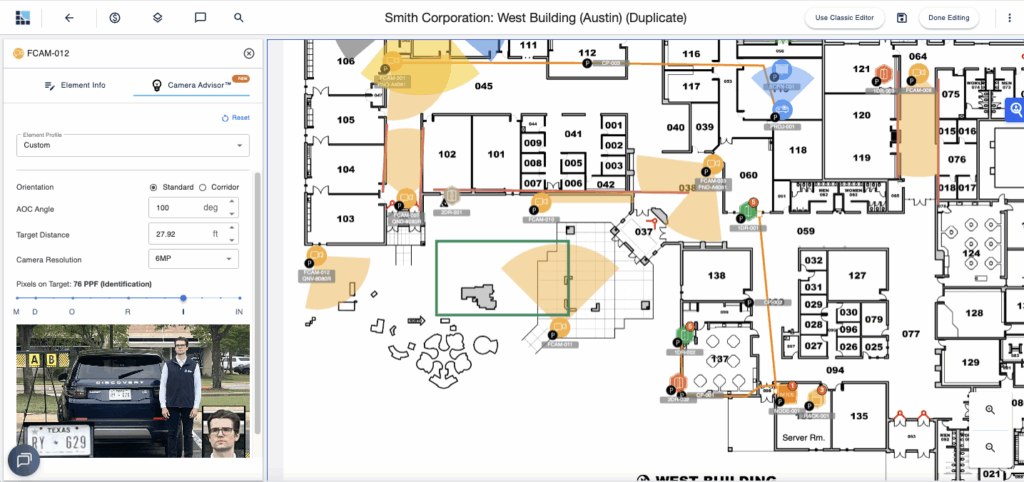
Forward-thinking integrators are shifting to digital capture and collaborative system design during the initial site walk. By documenting customer needs directly on a real floor plan or satellite imagery, clarity improves immediately. Customers can see exactly what you’re proposing, in context, as the conversation happens.
The result is faster alignment, stronger confidence, and shorter sales cycles.
Here are three specific benefits this refinement delivers.
Elevates Customer Perception
Showing up with a tablet and a structured digital design instantly signals professionalism. Needs, constraints, and device locations are captured visually, in real time. Compared to handwritten notes and follow-up PDFs, the contrast is obvious.
Visual, collaborative designs allow customers to understand solutions immediately—no guesswork, no translation required. The experience feels consultative, modern, and credible, building trust early.
Enables More Accurate Opportunity Qualification
Digital site surveys clarify scope sooner. Device counts, infrastructure limitations, environmental conditions, and customer preferences become visible during the site walk—not days later.
This allows teams to qualify opportunities earlier and avoid investing time in proposals that aren’t viable or aligned.
Improves Sales-to-Technical Handoff
A digital capture standardizes information from the start. Engineering, estimating, and operations receive structured, consistent inputs instead of deciphering notes or tracking down missing details.
The result is fewer follow-ups, fewer assumptions, and smoother internal transitions.
This leads directly to the next refinement.
2. Capture What Estimation and Operations Need Early
One of the most common breakdowns in the integrator workflow happens between sales, estimation, and operations. Sales teams leave a site confident, only for engineers to discover later that critical details are missing.
That leads to rework, return visits, delays, and rushed proposals.
A digital system design process helps close these gaps.
Aligns Teams on What “Complete” Means
With a standardized digital workflow, teams can define clear site survey requirements upfront. This often includes:
- Required photos
- Device placement notes
- Cable pathways
- Measurements
- Environmental conditions
- Access constraints
- Customer preferences
When everyone agrees on what “complete” looks like, consistency follows.
Captures Information at the Moment It’s Observed
Instead of reconstructing surveys back at the office, details are captured in real time. Information is fresher, more accurate, and immediately accessible to the broader team.
This eliminates hours of post-visit cleanup and accelerates proposal delivery without adding pressure to sales reps.
Eliminates Guesswork with Visual Documentation
Legacy methods leave too much open to interpretation. Digital system design introduces clarity through annotated photos, device attributes, and floor-plan-based layouts.
Engineers no longer interpret vague notes. Operations receive a clear blueprint. Change orders and installation issues decrease.
Reduces Workload and Improves Team Satisfaction
When teams aren’t chasing missing details or fixing avoidable errors, work moves faster and stress drops. Over time, accuracy and efficiency become standard, improving morale and reducing burnout.
3. Automate Bills of Materials to Accelerate Quotes and Protect Margins
Even with accurate designs, many integrators lose time and margin building quotes manually or engage in several rounds of rework. Copying part numbers, quantities, and accessories into spreadsheets is slow and error-prone. Missing or incorrect items can derail pricing, delivery, and customer trust.
Automation eliminates this risk.
Improves Speed and Accuracy with Automated BOMs
By generating bills of materials directly from the digital system design, manual entry or dual entry errors disappear. Quotes move faster, and sales teams spend more time selling, not formatting spreadsheets.
Strengthens Manufacturer Collaboration
Sharing digital layouts with manufacturers gives them real-world context. Detailed site data allows for better recommendations and fewer revisions.
Better collaboration leads to stronger designs and fewer surprises downstream.
Prevents Rework and Margin Erosion
Incorrect or incomplete proposals often cost the integrator, maybe less so than the manufacturer – so be sure to be cautious to skip the site survey and the details needed from the site survey.
Keep in mind that manufacturers are less likely to have the important details from the physical location which can lead to underestimating the project Automated BOMs and detailed designs increase first-pass accuracy, protecting margins while improving customer confidence.
Shortens Sales Cycles and Scales Growth
Faster proposals lead to faster decisions. Repeatable, documented workflows reduce reliance on individual heroics and create a foundation for scalable growth.
Modernize for Sustainable Growth
Manual processes can’t support modern integration businesses. Digital site surveys, early information capture, and automated BOM workflows deliver measurable improvements in speed, accuracy, and customer experience.
System Surveyor brings these refinements together in a single, cloud-based system design platform enabling teams, clients, and partners to collaborate visually with unmatched clarity. Check out the potential ROI for System Surveyor.
See what System Surveyor can do. Start your free trial today.
FAQs
A digital site survey uses software to capture detailed, dimension-accurate information during a site walk. Entire systems can be designed directly in the platform, including angles, coverage, and constraints.
Paper notes and scattered photos introduce uncertainty. Digital site surveys improve accuracy, visibility, and collaboration while projecting professionalism.
Much of the proposal work happens during the survey. Security system designs are more complete and visual, reducing rework and accelerating customer decisions.
Collaborative system design allows integrators, customers, vendors, and engineers to review and refine the same design in real time—earlier in the process—reducing costly revisions later.

Maureen Carlson is co-founder and president of System Surveyor, the leading digital platform for physical-security site surveys and system design. With 25 + years in B2B SaaS and security technology, she leads the go-to-market and operations with a top notch team. Under her leadership, System Surveyor has grown into an industry-defining software used worldwide to streamline system design, enable collaboration, and raise the bar for security and technology professionals. Maureen enjoys building relationships in the industry and user community to build sustainable, high growth business. In her spare time in beautiful Austin, you’ll find her spending time outdoors, on a tennis court, reading or with family and friends.