

Physical security system integrators have a proposal problem. Sometimes it hides behind other excuses (like pricing), but at the core, most lost proposals are lost because of a hidden variable: reporting quality.
The Hidden Variable in Proposal Success
Picture a sales rep doing a site walk, clipboard and smartphone in hand.
Your rep thoroughly walks the site, taking notes throughout the location and grabbing a handful of photos via phone camera. Then the sales rep calls it a day and heads home or back to the office.
The next day, your sales rep sits down to turn that site walk information into a proposal. Notes are scattered across photos, PDFs, pen and paper, and (eventually) multiple email threads. Here’s where the variables kick in:
- Device counts aren’t quite firm.
- Engineering has questions that the sales rep can’t find answers to in their notes.
- The manufacturer needs clarification.
- And then the kicker: the customer sees problems and asks for revisions.
Somewhere in those bullet points, the proposal stalls. Depending on who you ask, it was a pricing problem, or a competitor that outmaneuvered you, or a mismatch of budget timing.
But none of those are the true reason.
In system integration, proposals stall because of unclear reporting. Your reporting — especially the quality of your site survey documentation — affects every single downstream element. Proposal accuracy, internal alignment, customer confidence, and yes, proposal close rates.
Inputs Are the Real Problem
Ultimately, the proposal process (and proposals themselves) is broken because the inputs are flawed. But the status quo is powerful, and many integrators don’t immediately recognize where those upstream inputs are failing them.
We’d like to show you precisely how this happens.
Most Proposals Fail Upstream
To see the breakdown, let’s look at the typical proposal-building process in 2026:
Site walk → notes → photos → sketch → spreadsheet → proposal software → proposal
When we say that the proposal isn’t a problem on its own, what we’re getting at is that the breakdown is upstream of the proposal itself.
For example:
- Way back at the site walk, the sales rep missed door details.
- Photos don’t show certain camera needs, so your camera counts keep changing.
- Neither notes nor sketch contain enough detail on IDF and MDF, so inventory and bill of materials are inaccurate.
- The sales rep lacks the technical knowledge to detail power and network needs, so engineering needs clarification and follow-up.
These are just four of countless examples where the failure is baked in because the upstream processes didn’t accomplish everything you need them to do.
The result: when you don’t have complete documentation, the proposal becomes a moving target.
The Cost of “We’ll Fix It Later”
You’ve heard it, we’ve heard it, maybe even you’ve said it before: of course, not every detail is right after the site walk; that’s just how it works. We’ll never get it all right the first time; we’ll just fix it later.
It’s tempting to accept this, especially if you’ve never seen an alternative. But “we’ll fix it later” carries real (and really painful) costs in the form of more proposal revisions.
The less detail you capture, the more you’ll need to revise proposals. You’ll deal with internal back-and-forth (multiple rounds between engineering and sales, for example) and external revision requests (where your client points out things they noticed you missed or incorrect elements).
The downstream impacts of all these revisions are troubling:
- Revisions waste your and the client’s time and delay closing.
- The need for revisions weakens client confidence in your accuracy and ability.
- The slowdown opens a window for competitors to outmaneuver you.
- The extra time you spend on revisions for this client is time you can’t spend on your next client (or on pursuing new leads).
Ultimately, what are the costs of “we’ll fix it later”? Slower sales velocity, weakened customer trust, and reduced capacity. All because of poor reporting quality.
Reporting Gaps That Cause Proposals to Stall
We’ve seen the positive: great reporting helps you close sales and retain more profit.
Now let’s think through the negative: consider these 5 information breakdowns that can grind even the most promising proposals to a halt.
- Incomplete Site Documentation — Without the necessary details, integrators can’t build accurate, comprehensive proposals.
- Disconnected Photos — Photos without context are puzzle pieces rather than information sources, leading to questions like which corner is this? Why did I take a picture here?
- Scope Drift Between Sales and Estimating — Sales heard one thing from the customer and might have promised them something specific, but Estimating knows a functional system will take more equipment (and more budget).
- No Clear System Visualization — Because they can’t visually see what you’re proposing, customers must take your word that a PDF list of components covers everything.
- Poor Internal Reporting for Handoff — For large and scaling integrators who have several team members touching proposals (e.g., sales to operations handoff), weak reporting limits what knowledge downstream team members can access.
When reporting is weak, the proposal becomes a negotiation. When reporting is strong, it becomes validation.
Why Reporting Is Actually a Sales Tool
Fixing the reporting variable can flip the script, transforming reporting from something that interferes with sales into a powerful sales tool.
First, strong, visual reporting builds client confidence. Clients don’t buy line items in a spreadsheet or PDF. They buy clarity and the assurance of safety.
With visual-based digital site survey documentation such as what you can create in modern collaborative security system design software, you can show the client that you understand the site. You can point to exactly how you’ve mapped out their requirements and thought through any potential constraints. Ultimately, visual documentation, especially in collaboration with the client, reduces fear of unknowns and increases confidence that you can deliver what you say you can deliver.
Second, better security system reporting reduces rework and protects profit. With a visual design built in a digital site survey tool, all parties can notice omissions and mistakes before the proposal is finalized. Engineering can more easily catch missing device details, and the client can instantly recognize elements that don’t match their lived experience in the building. Fixing these issues collaboratively — before a contract is signed, a single part is ordered, or a truck rolls — saves time, labor costs, change order disputes, and more.
To sum up: visual alignment on a system design solves miscommunication early, lessens the cost and amount of rework, and protects your profits.
3 Ways Modern Reporting Wins More Sales
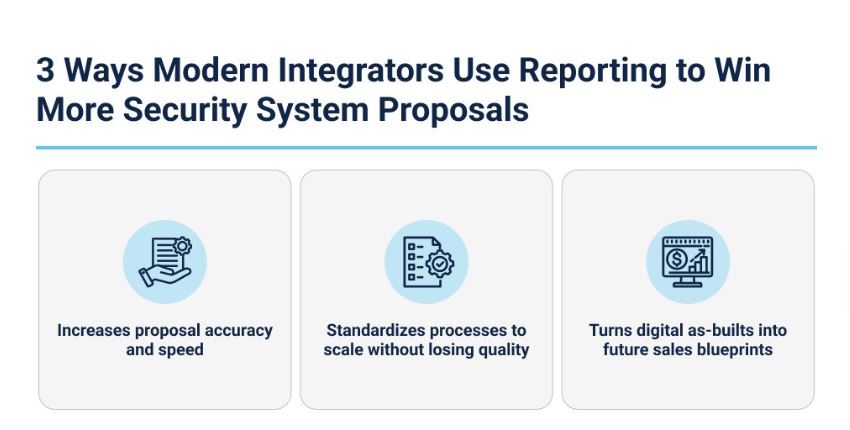
1. Increases Proposal Accuracy and Speed
System integrators don’t treat reporting as an afterthought. They use it as a competitive advantage in the sales cycle.
If you haven’t seen what modern security reporting can do for your proposal process, it can be difficult to grasp the full impact. Watch our Supercharge Your Sales video series for tips & best practices.
With a collaborative digital reporting platform, site surveys automatically translate into structured, visual, and client-ready documentation. Instead of stitching together notes, spreadsheets, marked-up PDFs, and disconnected emails, everything flows into a cohesive proposal foundation.
How this wins more proposals:
- Requirements are captured clearly and visually, reducing scope misunderstandings.
- Proposal creation becomes faster because documentation is already structured.
- Customers feel confident because they can see exactly what is being recommended and why.
- Fewer change orders and revisions reduce friction during the sales process.
When reporting is modernized, proposals become clearer, faster, and more aligned with customer expectations — increasing close rates and reducing delays.
2. Standardizes Processes to Scale Without Losing Quality
As integrators grow, inconsistent documentation becomes a hidden liability.
Processes that work well for experienced team members don’t always transfer to new hires. Informal workflows, tribal knowledge, and one-to-one training don’t scale. Over time, this creates inconsistency in proposals, missed details, and uneven customer experiences.
Modern integrators use standardized digital site survey and reporting processes to create repeatable excellence.
How this wins more proposals:
- Every project follows the same structured survey workflow.
- New hires ramp faster because documentation standards are built into the platform.
- Sales consistency improves across the entire organization.
- Critical steps are no longer missed due to informal processes.
Standardization reduces training time and improves time-to-value for new team members. More importantly, it ensures that every proposal reflects the same level of professionalism and precision — regardless of who builds it.
Consistency builds trust. Trust wins business.
3. Turns Digital As-Builts into Future Sales Blueprints
As integrators grow, inconsistent documentation becomes a hidden liability.
Processes
Modern reporting doesn’t stop at the proposal stage.
High-performing integrators use collaborative physical security system design tools to create a living digital as-built — a clear, up-to-date record of exactly what a customer’s system includes.
Unlike static PDFs or outdated diagrams, a digital as-built evolves with the system as it expands, ages, and components are replaced.
How this wins more proposals:
- Customers see long-term partnership, not just a one-time install.
- Upgrade opportunities are clearly documented and easier to recommend.
- Service agreements become more strategic and recurring.
- Integrators position themselves as security service providers, not project vendors.
The digital as-built becomes a roadmap for future enhancements, lifecycle upgrades, and recurring revenue. It transforms reporting from a tactical sales document into a long-term growth engine.
hat work well for experienced team members don’t always transfer to new hires. Informal workflows, tribal knowledge, and one-to-one training don’t scale. Over time, this creates inconsistency in proposals, missed details, and uneven customer experiences.
Modern integrators use standardized digital site survey and reporting processes to create repeatable excellence.
How this wins more proposals:
- Every project follows the same structured survey workflow.
- New hires ramp faster because documentation standards are built into the platform.
- Sales consistency improves across the entire organization.
- Critical steps are no longer missed due to informal processes.
Standardization reduces training time and improves time-to-value for new team members. More importantly, it ensures that every proposal reflects the same level of professionalism and precision — regardless of who builds it.
Consistency builds trust. Trust wins business.
How to Evaluate Your Current Reporting Process
Not sure how your current reporting process stacks up? Use this actionable 7-step checklist as a digital check-up.
- Can you accurately estimate the price from your site documentation alone? If not, you lack the ability to accurately qualify leads and price services early. But an automated bill of materials based on a visual system design makes this possible.
- Can your PM execute without clarification calls? Capturing enough data on the site survey to execute the first time really is possible with the right tools.
- Can your customer visualize device placement? Text-based lists of part numbers and quantities don’t engender trust, and “just trust me” isn’t a viable long-term strategy.
- Is every device tied to a specific location? Your sales and engineering teams should know exactly where every proposed line item is going (and be able to show this to customers).
- Are your photos connected to floor plans? A photo without context is at best a puzzle piece. A photo tied to a specific point on the floor plan is data that empowers good design.
- Can you reuse your site data later? Is it dead the moment you hit “send,” or can you continue editing and iterating your system design over time?
- Are you regularly executing proposals without revisions involving missing details? Some revision is inevitable, but if most of them are because you missed elements, consider it a red flag.
How did you score? If more than two answers above were “no,” reporting is likely costing deals.
System Surveyor Turns Reporting into a Revenue Driver
System Surveyor is the modern, collaborative system design tool that security integrators rely on to bring their system design and reporting into the modern era. Visual, interactive system designs built atop a digital floor plan add immense data and refreshing clarity to every design. Customizable, professional-grade system reports boost your team’s reporting abilities with system layouts, automated BOM, integrated site photos, and even an installation schedule.
Explore what System Surveyor can accomplish for your team: Start a free trial.
FAQs
The hidden variable behind stalled security system proposals is reporting quality. When a site survey lacks accurate detail or clarity, problems cascade downstream from inaccurate device counts to engineering delays and customer revisions. Strong reporting eliminates uncertainty early and keeps proposals moving forward.
A poorly performed site survey leads to inaccurate device counts, missing infrastructure details, unclear network requirements, and scope misalignment between sales and engineering. These issues force proposal revisions, slow down sales cycles, and increase the risk of losing deals to competitors.
Modern digital reporting tools convert site surveys into security system designs tied directly to floor plans. This improves proposal accuracy, reduces rework, speeds up estimating, and allows customers to clearly visualize system design.
Reporting should be treated as a sales tool because it directly impacts customer confidence, proposal clarity, and close rates. Collaborating on a digital security system design in real time helps customers understand exactly what they’re buying, reduces fear of unknowns, and minimizes costly revisions. When reporting improves, sales velocity and profitability improve with it.
System integrators evaluate their reporting process by asking: Can we estimate accurately from site documentation alone? Can project managers execute without clarification calls? Can customers visualize device placement? If the answer to several of these questions is no, reporting gaps are likely slowing sales velocity and reducing win rates.

Maureen Carlson is co-founder and president of System Surveyor, the leading digital platform for physical-security site surveys and system design. With 25 + years in B2B SaaS and security technology, she leads the go-to-market and operations with a top notch team. Under her leadership, System Surveyor has grown into an industry-defining software used worldwide to streamline system design, enable collaboration, and raise the bar for security and technology professionals. Maureen enjoys building relationships in the industry and user community to build sustainable, high growth business. In her spare time in beautiful Austin, you’ll find her spending time outdoors, on a tennis court, reading or with family and friends.